Auto
Richmond Auto Insurance Premiums: Could Richmond Actually Be One of the Cheaper Areas?
When people think of Richmond, some may immediately recall the traffic accidents that have taken place there.
Some accidents are particularly dramatic and leave a lasting impression. Over time, this can lead people to believe that Richmond drivers tend to be more aggressive, traffic accidents happen more frequently, and auto insurance premiums must therefore be higher for Richmond residents.
In reality, however, the impression a city leaves on us is not necessarily an accurate reflection of its overall insurance risk. Nor does it mean that drivers living there must pay higher premiums.
In British Columbia, where you live is indeed one of the factors that affect your auto insurance premiums. However, the risk assessment behind your premium is not based simply on public perceptions of a particular city.
1. Why Do People Think Richmond Has So Many Traffic Accidents?
I believe many people living in Metro Vancouver have either heard about or personally witnessed traffic accidents in Richmond.
Some incidents are particularly dramatic and easily become topics of conversation. Others spread widely across social media, making them even more memorable.
But here is an important question to consider: Do we remember the most memorable accidents, or do we have an accurate picture of all the accidents that occur in an area?
A particularly dramatic accident may leave a lasting impression on many people. By contrast, everyday incidents—such as scraping a vehicle in a parking lot, colliding while turning, or minor accidents on busy roads—may attract far less attention or never make the news at all.
Therefore, it is difficult to accurately determine which city has a higher overall traffic accident risk based solely on news reports, online discussions, or personal impressions.
2. Vancouver Also Has Its Own Driving Challenges
If we turn our attention to Vancouver, we can see another set of potential driving risks worth considering.
Some neighbourhoods have relatively narrow streets, while residential areas, commercial districts, street parking, and pedestrian activity can be concentrated in the same spaces. Drivers may need to be particularly careful when turning, parking, navigating intersections, or sharing the road with other road users.
In these environments, the risk of minor collisions in everyday driving is still worth considering, even when there are no major or dramatic accidents.
Not every traffic accident makes the news, either. Many ordinary collisions involve only vehicle damage and may simply result in an insurance claim that needs to be handled.
So, while Richmond may stand out in our minds when we think about traffic accidents, we should not overlook the everyday driving risks faced by densely populated cities like Vancouver, where traffic activity can also be substantial.
3. What Do the 2025 Metro Vancouver Accident Distribution Data Show?
According to the 2025 Metro Vancouver traffic accident distribution map, Vancouver and Surrey have relatively high accident frequencies, followed by Burnaby and Richmond.
This may help us reconsider why Richmond often has a reputation for having many traffic accidents, while recognising that this perception does not necessarily mean its auto insurance premiums must be the highest.
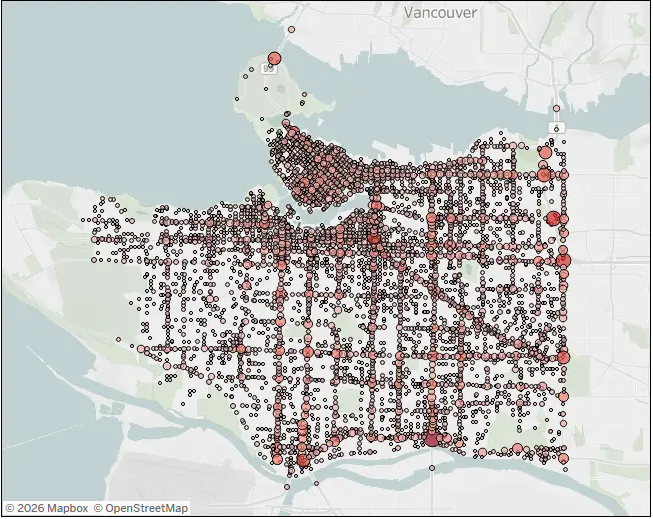
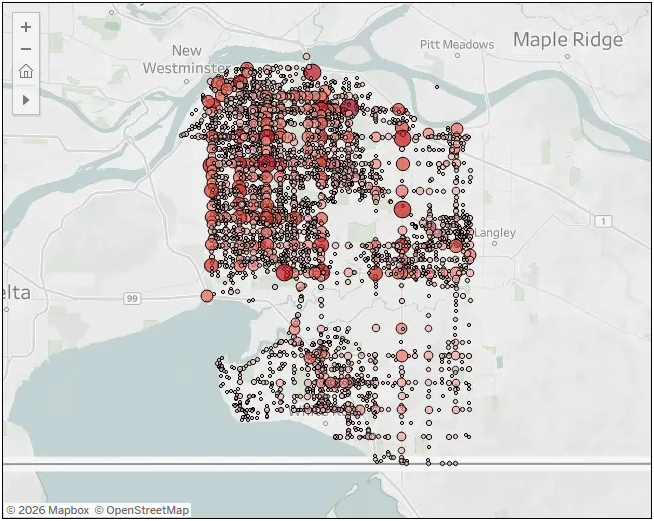
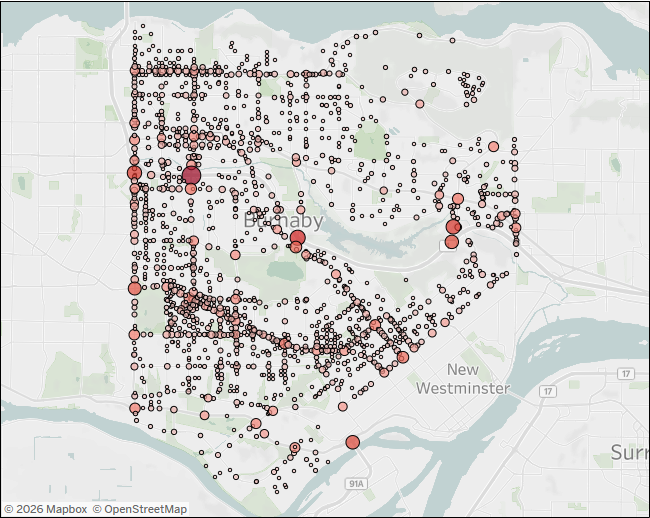
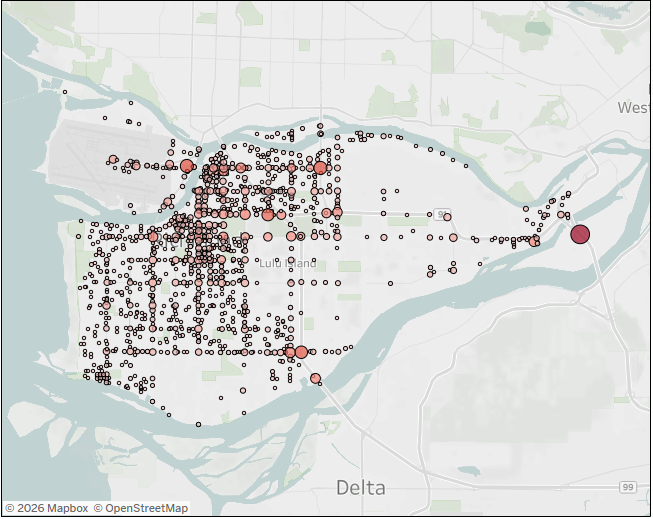
It is important to note, however, that accident distribution data alone do not establish which city has the highest accident rate or insurance premiums. The interpretation also depends on what the data measure, such as total accident counts, accident frequency, or accident rates relative to the number of vehicles or drivers.
4. How Does ICBC Take Your Location into Account?
According to ICBC’s official guidance, your location is one of the factors that affect your auto insurance premiums. British Columbia is divided into different insurance territories based on geographic areas and relevant risk characteristics, reflecting differences in traffic conditions and other driving risks.
However, accident frequency rankings and actual insurance premiums cannot be directly equated. ICBC also considers factors such as a driver’s experience and crash history, vehicle use, where the vehicle is primarily located, and the coverage selected.
At a broader level, insurance pricing considers the likelihood of future claims and the potential cost of those claims, alongside the other factors applicable to the policy.
As a result, living in the same city does not mean that you and every other driver will pay the same premium.
Even if two drivers both live in Richmond, their premiums may differ significantly because of differences in driving experience, crash history, vehicle model, vehicle use, or coverage choices.
5. Is Auto Insurance Really Cheaper in Richmond Than in Vancouver or Burnaby?
There is an important distinction to make here: an individual auto insurance quote in Richmond may be cheaper than a comparable quote in Vancouver or Burnaby, but that does not prove that Richmond’s overall premiums are always lower.
Actual premiums vary depending on the driver, vehicle, coverage combination, and applicable territorial rating.
To make a fair comparison, you would need to use the same or similar driver information, vehicle, usage, and coverage settings before comparing quotes across different locations.
Similarly, even if an area has a higher total number of accidents, it does not necessarily mean that every driver living there will pay a higher premium.
Total accident counts, accident frequency per insured vehicle, and the average cost of each claim are different measures. They should not be treated as interchangeable.
Rather than assuming that Richmond must be more expensive, it is more useful to compare actual quotes and see how the location affects your own premium.
Conclusion: Don’t Judge Insurance Premiums by Impressions Alone
Traffic accidents in Richmond may leave a strong impression, but that does not mean auto insurance premiums there must be higher than in Vancouver or Burnaby.
Vancouver’s street layout, traffic density, and road-use conditions in different neighbourhoods are also worth considering. However, determining which area has a higher accident risk or more expensive insurance ultimately requires appropriate data, rather than relying solely on individual incidents or online discussions.
For drivers, the most practical approach is not to guess which city offers cheaper insurance, but to obtain quotes based on their own circumstances when purchasing a vehicle or renewing their policy.
If you are planning to move, buy a car, or simply want to understand how your location affects your auto insurance premiums, consider speaking with an insurance broker. Understanding the factors that influence your quote can help you plan your vehicle ownership budget more accurately.
This article is general information only. Your actual coverage is set out in your policy wording.